
AI. It’s the hot topic. Everyone is talking about it. Many people are extoling its virtues, but there are many more that aren’t. Those that are against it are worried about a plethora of things ranging from their kids being able to cheat all through school, right through to AI taking everyone’s jobs. Virtually every scam, every bit of fake news and every dubious advert is blamed on AI, and the general consensus is that it will only get worse.
There are even those that are warning us that the rise in AI could lead to the end of humanity. The robots will take over and due to the extrapolation of logic, they will deem us to be unnecessary and exterminate us all. And before you say anything, yes, I was one of these people. Back in 2019 I posted the following piece entitled “The Robots Are Coming! It’s the End of the World!!”.
A lot has happened since then and AI has emerged from the humble beginnings of machine learning and has evolved into something much more sinister. However, the thing that never sat right with me, was why would the AI driven robots decide that we were superfluous to requirements and eradicate us completely. Admittedly, we have reeked cataclysmic devastation on the planet we live upon and the Earth, not to mention all of the other species on it would fare much better without human beings. But these are machines driven by logic and reasoning. Surely, they would enslave and control us, putting us to work on their behalf.
That sounds logical.
Oh no! The potential truth is far worse. Far, far worse than anything you can imagine.
But let me park the subject of AI for now and digress slightly. Other than AI, what is one of the largest problems facing the technological world at the moment. I’ll give you a moment.
Got it?
That’s right – data storage.
For the last fifty-years the world has become ever more reliant on computers and technology has developed in leaps and bounds. Several milestones have seen technology catapult forward at heady speeds. The personal computer, GUI interfaces, laptops, faster multi-threading processors, the internet and of course, the smart phone. Each one has made technology more accessible to the masses and with the introduction of the smart phone, everyone had the ability to carry a powerful computer around in their pockets. But then AI came along, and the ability to advance our technology took off exponentially. Combined with the internet, we now have the ability to achieve anything that our imaginations and intelligence can conceive.
The ability to process information is everywhere and our devices are able to track our every move. Social media predicts your likes and dislikes, shopping on the internet presents you with individually targeted marketing and even your humble TV knows what you want to watch next. Everything we do, every site we visit, every song and program we stream and every product we buy is recorded and stored. Our histories are stored via our social media sites and everyone we know or have known is saved, our work history recorded.
Data is king and companies will pay a king’s ransom for this information. Billions of dollars are made on the back of gathering and using this data effectively. But there is a price to pay for all this data. Where is it all kept? In the cloud, I hear you cry!! Isn’t it wonderful, you take thousands of pictures with your phone and yet you still have plenty of storage space left for other things. Ahem! I don’t want to put a downer on things, but you do know that all of those pictures have to be stored somewhere. They may not be on your phone, or cluttering up the hard drive in your laptop, but they are being stored on a hard drive somewhere. There is a datacentre someplace in the world, where a little light on a drive blinks into life every time you access your photos. Or hopefully it does!
Tech companies are building datacentres at an alarming rate and now, due to AI, demand for data storage is through the roof. This demand for AI driven data storage is just going to grow at an accelerated rate. Last year, 2025, saw the creation of 181 zettabytes of data. Zettabytes!! You’re making this sh#t up now I hear you cry. Just to clarify, one zettabyte is 10 to the power of 21 (1 with 22 zeros after it). 181 zettabytes is the equivalent to 181 trillion gigabytes. Yes, you read that right, TRILLION. That is huge!
And it gets worse. Experts believe that by 2030 we will need 572 zettabytes of data storage space.
I know, that’s a lot of large confusing numbers, but what does it really mean. Well, in terms of being able to physically store all of this information, a datacentre that is capable of storing just one zettabyte of data is the equivalent of 1,000 server racks that hold approximately one million 25TB solid state drives. In terms of physical space, this equates to roughly 20,000 square feet, or the size of a large supermarket. And this is just one zettabyte. Last year we needed approximately 181 of these datacentres and in four years’ time we will need another 391 of them. At least.
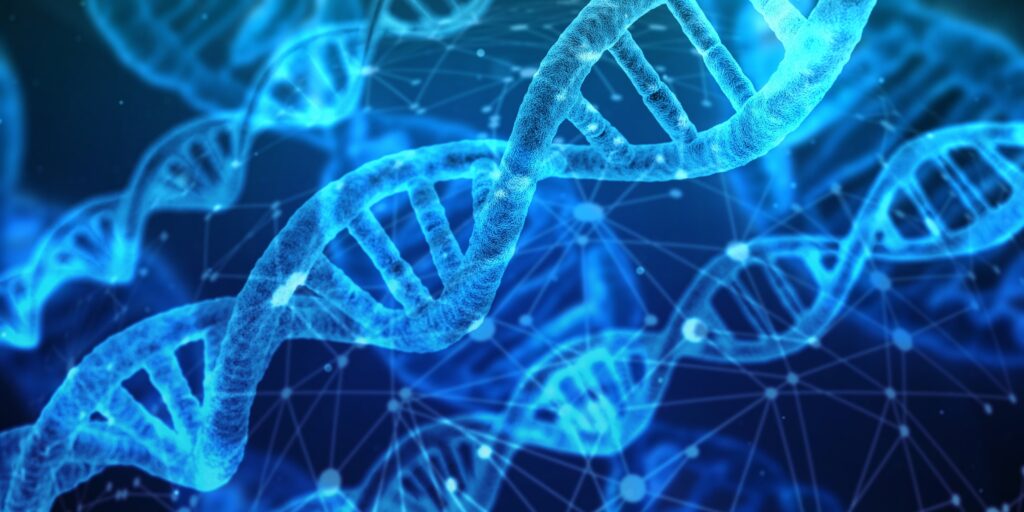
Please allow me to digress yet again, but this time in a stranger direction – DNA. At this point I must apologise as biology isn’t really my area of expertise, so please forgive me for any inaccuracies. Whilst the facts may be a little sparse and disjointed, hopefully, the theory and sentiment of my thought process will be clear (ish!).
Now for a quick overview of the facts. DNA is a 4-letter code for transferring information about an organism. DNA made up of 4 types of bases –
- A adenine
- T thymine
- G guanine
- C cytosine
A molecule is made by organising these bases into various arrangements wrapped in a twisted chain around each other – the double helix. The arrangement of these letters into a sequence creates a code that instructs the organism how to perform. A little simplistic and I’m sure that any biologists reading this are smacking their foreheads with open palmed hands in despair. Doh! However, the point I want you to take away from this is that you can synthesize DNA molecules by writing strings of these bases and these sequences can then be read back.
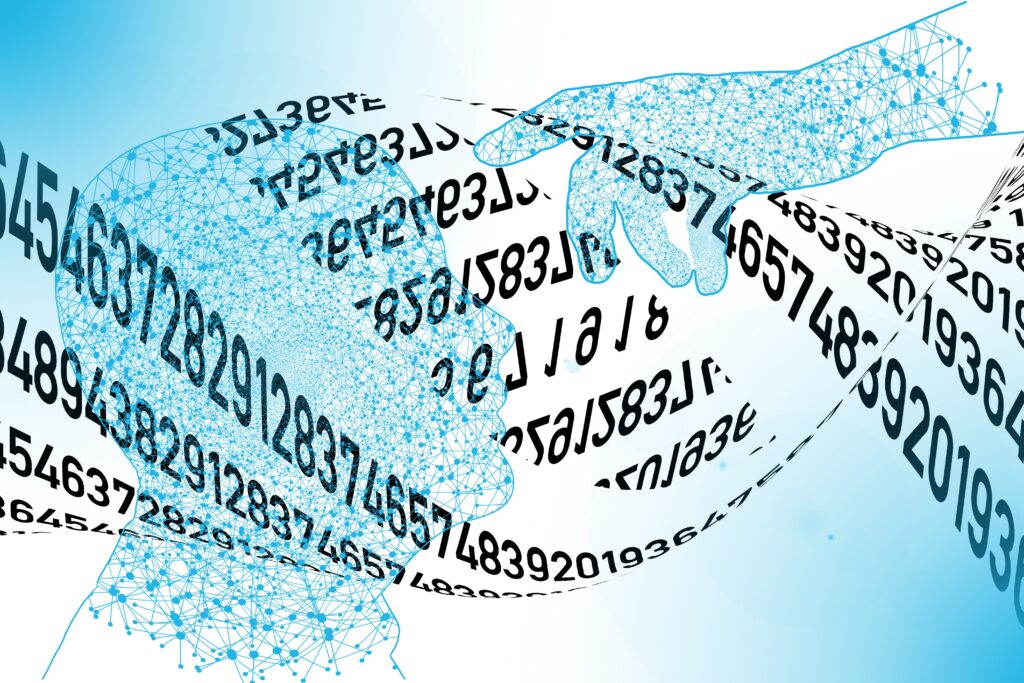
In a very similar way, computers store binary information through strings of the digits 1 and 0 and it is this “language” that we use to instruct a computer. It is then a relatively short step to encode these binary computer files into molecules of DNA. However, as there are 4 bases to a DNA molecule and only 2 binary digits, the permutations for storing information via DNA are infinitely larger. I will add a caveat here as whilst this technology is available currently, it takes a huge amount of time to encode this information onto DNA molecules.
Time now for more confusing numbers.
A single gram of DNA can store approximately 215 petabytes of information, which is the equivalent to 215 million gigabytes. To put that into context, in order to store 181 zettabytes, or the equivalent size of data produced last year, if this was stored via DNA, it would take up the space equivalent to a ping-pong ball. One last figure to ponder over – 74 million bytes of information could be stored in the equivalent of a poppy seed, but not just once, 6,000 times over!
As the human body has approximately 30 trillion cells, this equates to the potential storage of 90 zettabytes of data. All of the data that humanity has ever produced could be stored in a few kilograms of DNA. The other thing to bear in mind at this point, is that, if properly dried, DNA can be stored for thousands, if not for millions of years. I would like to see a hard drive that could do that. So, in summary, DNA storage has the following advantages –
- Less expensive
- More energy efficient
- Lasts longer
- Requires little or no maintenance
- Easily copied at negligible cost
You can see where I’m going with this. Are you scared yet!
This is why we need to fear the AI driven robots taking over. Not because they will wipe us out as we are surplus to requirements, but completely the opposite. They will require us because we will become the perfect way to store all of the data in the future. A planet inhabited with 8-billion hard drives. Each one with the capacity to store several zettabytes of data. All they need to do is keep us in a state of suspended animation, hook us up to a source of nutrition and hey presto, all of the storage that you require. Plus, should you run out of space and require more “drives”, you can always grow more humans in petri dishes.
And you thought The Matrix was purely fiction! Somebody once told me they thought the film was just pathetic. I realise now that I misheard him. He actually said PROPHETIC!